
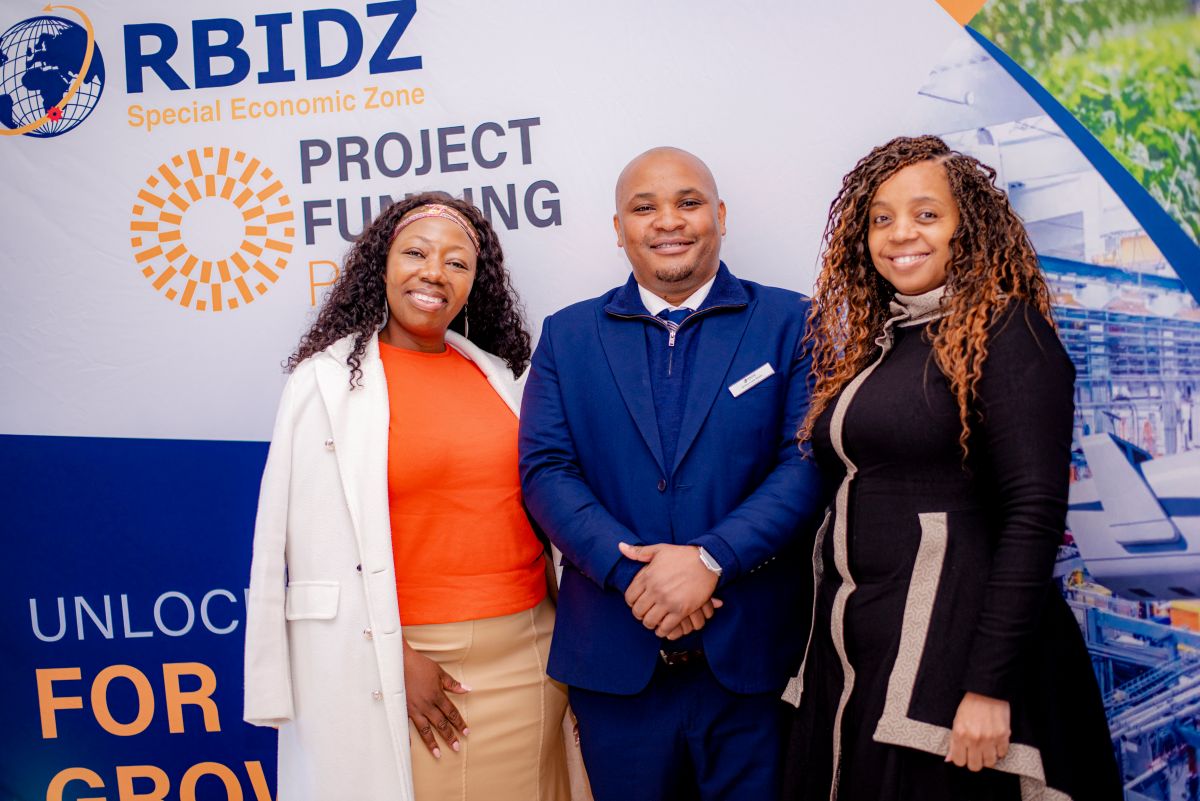
RBIDZ Project Funding Pitch Session- Johannesburg- 7-8 May 2026
The Richards Bay Industrial Development Zone (RBIDZ) showcased a selection of companies actively investing in, and developing projects, within the programme, during a two-day funding pitch session held in Johannesburg on May 7 and 8.
With the aim of attracting development finance institutions (DFIs), funders and commercial banks, besides others, the funding pitch served as a platform to advance meaningful engagement between credible projects and the capital needed to bring them to life.
The RBIDZ exists as a strategic instrument of government, established to give effect to the Special Economic Zone (SEZ) programme, which is designed to drive industrialisation, inclusive economic development, job creation and skills development, said RBIDZ CFO Simangele Mvelase.
“The programme, at its core, recognises that, for the economy to grow meaningfully, investors must thrive, industry must expand and grow and growth must translate into tangible social economic outcomes.”
Described as a national asset for industrial growth and home to dozens of investors expanding critical industries for South Africa, the RBIDZ is backed by a strong enabling policy environment and supported by provincial and national government, including the KwaZulu-Natal provincial government, the KwaZulu-Natal Department of Economic Development, Tourism and Environmental Affairs and the national Department of Trade, Industry and Competition (dtic).
Mvelase said the RBIDZ firmly believes that creating platforms to support investors is central to its mandate.
The funding platform, designed to address the gap between project readiness and access to appropriately structured funding, was established to facilitate the conversations required to unlock access to capital and create structured engagement between projects and financial institutions.
This will enable informed discussions about funding structures and risk allocation, accelerate pathways to financial close and ultimately unlock industrial development and economic impact as support is provided to each other.
“There is an important need to support these projects from the inception point, from the planning phase, where the risk is high. The commercial banks tend to shy away from this,” Industrial Zones Programme (IZP) chief operations officer Stieneke Jensma said, adding that industrialisation is critical for the country.
“This is where we create jobs. It grows the economy. South Africa’s GDP is highly impacted by what happens in the SEZs.”
The IZP was established, as an entity of the Industrial Development Corporation (IDC), to accelerate the implementation of SEZs, a platform where the government and the private sector partner.
For SEZs to continue to offer an enabling environment, critical infrastructure investment is required.
“The dtic has, to a large extent, covered the bulk and also covered the top structure. However, the SEZs are growing, so we need more play from the financial institutions.”
Industrial Zones Programme (IZP) senior technical advisor Mxolisi Matshamba, describing the IDZ as a critical intervention for government to drive, particularly at this stage of South Africa’s economy, reindustrialisation, added that the SEZs provide incentives and streamlined regulatory environments to unlock the productive capacity of the economy and actually integrate local enterprises into global value chains
They are the cornerstone of the country's industrialisation strategy, designed to attract investment, exports and create sustainable jobs by offering a world class infrastructure.
“What is important is to provide the critical support for those who are entering the market. We cannot rely only on DFIs. We need to be able to actually crowd-in the private sector,” he said.
Partnering with commercial banks and other funders will also provide access to their capacity and balance sheet to undertake the critical due diligence to determine the viability of projects.
With the concentration of the RBIDZ project pipeline currently in the bankable feasibility study (BFS) stages, it is critical bring together capital providers and project promoters to share project progress, unpack the interventions that the State is undertaking to derisk a particular project, where the gaps are in terms of funding and the best path forward in accelerating these projects, explained RBIDZ business development executive manager Simthembile Mapu.
“South Africa is in desperate need of accelerated industrialisation and initiatives like this allow us to be able to accelerate the efforts that we have on the ground in terms of making sure that we manufacture more in the country”, he said.
Currently, South Africa is a net importer of most products that are used on a daily basis.
“There is an opportunity for us to change that narrative and story, and initiatives like this allow us to be able to do that and move South Africa up the value curve in terms of manufacturing.”
Mvelase assured attendees at the pitch event that the projects presented during the pitch sessions have undergone extensive screening to ensure they are credible, valuable and aligned with the expectations of both the DFIs and commercial banks.
A Robust Pipeline
The RBIDZ has built a robust and a diversified investment pipeline valued at R248.7-billion, with 21 investors advancing projects spanning energy, advanced manufacturing, logistics, metals beneficiation and agro-processing, Mapu explained.
About R4-billion of this has already been operationalised, with the balance progressing through the construction, financial close and feasibility stages, supporting over 7 300 construction jobs and providing more than 500 sustained operational jobs.
Of the 21 projects in the pipeline, 12 are currently in the BFS stage, equating to a value of about R172.6-billion. Four projects are in the financial close stage and two projects are currently under construction.
The speakers highlighted the multibillion-rand Nyanza Light Metals project, housed in the RBIDZ, which is starting site piling within the next month ahead of its construction of a R15-billion titanium dioxide pigment manufacturing plant, the only one of its kind in Africa.
It will employ 3 000 people during construction and support up to 850 permanent jobs when in operation.
The RBIDZ is also progressing with the establishment of the RBIDZ Utility Subsidiary intended to support the delivery of critical infrastructure within the zone, said Mvelase.
This will enable the provision of key utilities such as energy and water, enhance the capability of investor projects, create opportunities for structured infrastructure investment and contribute to the financial sustainability of RBIDZ.”
The platform seeks to facilitate the implementation of gas infrastructure, renewable energy projects, floating nuclear power solutions and associated utility infrastructure through ring-fenced special purpose vehicles.
“This marks an important evolution in RBIDZ’s role, from an enabler of investment to also becoming a participant in a commercially viable infrastructure solution for our funding partners,” she continued.
Meanwhile, other presenters during the investor pitch session included Bote Industries, which is developing an R240-million industrial hose manufacturing facility within the RBIDZ.
The project focuses on local manufacturing, import substitution, industrial capability development and regional skills transfer.
The project is currently at an advanced stage of construction with commissioning anticipated before the end of the year.
Speaking on the opportunity presented by the platform, Bote Industries founder and MD Tebogo Masuku said the company is leveraging the platform to pitch for expansion investment and discuss its growth strategy.
“We have already invested R220-million on the first phase. At this point, we are looking for an additional R102-million for our expansion. Overall, we are looking at about R302-million investment for Bote industries.”
Meanwhile, coatings manufacturer Prostar Export Paints is also expanding its operations within the RBIDZ, with an estimated investment value exceeding R270-million.
Prostar Export Paints MD Vergan Kumar said the facility would produce a range of industrial, marine, protective and specialised coatings for domestic and export markets.
“Part of our expansion plan is to grow our business into the rest of Africa, specifically the export market. So we are looking for seed capital to grow our business into the expansion phase, and being located within the SEZ, it eases the export of our products out into Africa and the rest of the world.”
The project’s initial capital cost is estimated at R93-million, with an expansion up to R1.2-billion proposed.
Also within the RBIDZ is black-owned advanced materials company EMv Nanomaterials, which is developing a R468-million nano precipitated calcium carbonate manufacturing facility.
According to EMv Nanomaterials founding director Zane Abrahams, the project introduces proprietary nanotechnology manufacturing capability to support multiple industrial sectors, including plastics, coatings, paper and rubber.
The project is currently progressing through the financial close stage and additional funding will enable the company to expand supply throughout Africa and into the Middle East.
Meanwhile, Mapu highlighted the other companies investing and establishing facilities within the RBIDZ that attended the pitching session.
These include Genesis Hexicon, a joint venture between South Africa-based Genesis Eco-Energy Developments and Swedish Hexicon, which is developing a floating offshore wind farm off the coast of Richards Bay.
The R56-billion Gagasi Floating Offshore Wind project comprises an 800 MW floating offshore wind farm using advanced floating turbine technology suitable for deep-water deployment.
Ukhozi Africa Technologies is developing a phased vanadium energy-storage manufacturing platform within the RBIDZ, with an estimated investment value of about R1.4-billion. The project is currently at the BFS stage.
Further, independent power producer (IPP) Mabasa Energy and Fuels is developing a R10.9-billion, 750 MW combined cycle gas turbine power plant, designed to provide reliable baseload and flexible power generation capacity in support of South Africa’s energy security objectives.
The project is currently progressing through the BFS and IPP procurement preparation stages.
The project is currently progressing through the BFS and IPP procurement preparation stages.
SITS Equipment Group is developing a R350-million forklift assembly and manufacturing facility, with a focus on the assembly and manufacture of diesel and electric forklifts for domestic and regional markets across the Southern African Development Community region.
The project is currently undertaking capital raising and feasibility-related activities.
In addition, Amara Energy Company is developing a R2.25-billion bulk liquefied petroleum gas import, storage and distribution facility within the RBIDZ.
The project, currently at the BFS and environmental approvals stage, includes bulk storage infrastructure, logistics interfaces and distribution systems designed to serve industrial and commercial energy markets.
Novare Tech is developing a chlorine production facility, with an estimated investment value of about R300-million. The project is currently at the BFS and regulatory assessment stages.